Get Uvi Electric Piano Free For Mac

Electric keyboards have warmed the sound of many famous recorded tracks from the past, and now UVI has collected an extensive number of those instruments in one product.
by Rob Mitchell, July 2019
UVI is the music software company that is well known for their high quality sample libraries, effect plugins and their flagship synth/sampler Falcon. In case you haven’t noticed, we have covered many of their products in past issues of SoundBytes Magazine. Here are just some of those products we’ve covered: Falcon, FM Suite, PX V8, String Machines 2, OB Legacy and Vintage Vault 2. As it turned out, we are also reviewing another recent, and similar, UVI collection in this issue: Key Suite Digital. You can find that review here.
For this issue I will be examining UVI’s latest product called Key Suite Electric. We recently covered Key Suite Acoustic which focuses on sampled acoustic keyboard instruments. With Key Suite Electric UVI switches gears to reincarnate a number of electric keyboards from the past.
Key Suite Electric’s main focus is on the warm/sweet and sometimes even slightly distorted electric piano sound. With this collection you’ll get access to a huge sampled library from which to choose for your track’s sounds. Speaking of huge, here are some numbers for you: 62+ GB of WAV sample files were reduced to about 14 GB using FLAC encoding. If that sounds like a large amount to you, well… you’re right. Over 53,000 samples are here and 476 presets are included. That’s quite an undertaking by UVI as only two other products by UVI (in my collection anyway) have a larger file size: Vintage Vault Vector Pro (nearly 17 GB) and Digital Synsations 2 (nearly 18 GB).
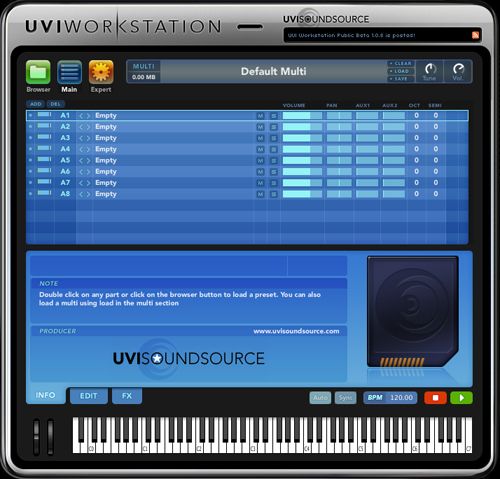
To install it you will need the free UVI Workstation or Falcon and a PC (64-bit Windows 8+) or Mac (64-bit OS X 10.8+) with the iLok Manager software installed (iLok dongle optional). Supported formats include AU, AAX VST and Standalone. For this review I checked it out using the UVI Workstation.
After you’ve loaded Key Suite Electric into the UVI Workstation or Falcon you can browse through the sampled instruments within the various categories: Tines, Reeds, Electric Pianos, Clavs, Electro Acoustic, Analog Keys and Bass. Here’s a brief overview of the different keyboard types: Tines-based keyboards used metal tines in place of strings, such as what you’d find in a standard piano. The reeds-based keyboards were similar in some ways to the tines keyboard type but used metal reeds to create their sound. The electric piano type used piezo pickups to amplify the sound from the strings allowing for a smaller form factor. The clav keyboards used steel strings and an electric pickup. The electro-acoustic keys used varied mechanics from model to model to generate their audio. The analog-based keyboards used analog synthesis to imitate the sound of a keyboard which may sound similar to a piano or other types of keyboards. Finally, we have the bass keyboards which used a few different types of sound generation methods (including synthesis).
Flute, choir, organ, strings, piano, and many more sounds; Sounds. The sounds from the UVI Mello are top-notch. My favorite has to be the strings and choir since they sound so dark and ominous. UVI Mello is a serious plugin that I highly recommend checking out. I think that it is a great option for producers of all levels as it is easy.
Along with the variety of individual instruments spread out over those categories, there are variations that have been added which make use of some other settings on the instrument itself or the settings within the UVI host software. Those UVI settings include such features as the envelopes, filter, tone settings and effects. The actual list of various instruments that have been sampled is very long, so I won’t bother to name them all. I will however give you a shortened list just to whet your appetite. You may or may not have heard of every one of these (I know I haven’t) but just check out some of the included instruments: RMI ElectraPiano, Viscount Intercontinental, AP-30, Yamaha CPiano 10, various Hohner Clavinet models, Kawai EP-308, Helpinstill Roadmaster, Pianoforti C77, Rhodes MK II 73 and CP30. One surprise entry for me was the Taurus bass pedals (called El Toro) in the Bass category. The El Toro is a welcome addition as I am a big-time synthesizer enthusiast and the Moog line-up has always been special to me.
Once you’ve loaded an instrument you’d like to use you’ll see the main display which shows a representation of the instrument that was sampled. Edirol ua 4fx drivers for mac. Below the graphic of the instrument there may be a few extra controls (depending on the instrument you loaded) that let you adjust two microphone volume settings and turn them on or off. On the right side is a Velocity setting where you can adjust the MIDI velocity curve. The main buttons that are on every instrument are for switching between three pages of controls. There’s the Main page that I just covered here, as well as the Edit and FX pages.
On the Edit page you can enable a filter and select between three filter types: low pass, band pass or high pass. Standard cutoff and resonance controls are also here. Over to the right are the two envelopes; one for the amplitude and the other is for the filter. Both envelopes are of the ADSR type. The amplitude envelope has settings to change the velocity sensitivity, and there’s an Attack button which will enable mapping of velocity to the attack stage of the envelope. The filter envelope has a depth setting and a velocity control to adjust the amount that velocity will affect the filter cutoff. Toward the bottom are settings for Tone, Pitch and Mod Wheel settings. The Tone control will adjust the tone from a brighter sound with a bit more attack to a more muted tonal quality, or anywhere in between. In the Pitch section you can enable the mono setting, adjust glide time and the Depth control will adjust how much the pitch glides up/down to the notes you play. The Mod Wheel section lets you enable vibrato, tremolo and filter cutoff settings for use with the mod wheel.
In the lower left are settings to adjust the sustain and release volume levels. Depending on the instrument you’ve loaded you may also find a control to adjust the sustain pedal sound. Over on the right side is a balance setting between the high and low keys and you can adjust the polyphony amount.
Key Suite Electric contains many high quality effects including a stereo IR processor (includes many impulse response types), Drive/EQ, Stereo Modulator (includes four different effect types: Phasor, Thorus, Flanger and Rotary), Digital Delay, Sparkverb, Tremolo and Wah units. UVI also offers full versions of a few of those effects as separate products: Rotary, Sparkverb and Thorus. These all work well and sound great, and the newer interfaces for the effects look very nice.
You may also get to some extra settings for the effects (not found on the front display) by clicking the Effects tab at the top. Effects can be disabled there and you check out the long list of alternative effects to use in place of the list I mentioned earlier. If you do add a new effect, it won’t show up on the Key Suite Electrics main FX page with the colorful and well-designed interfaces I was mentioning earlier. In other words, to make any adjustments to an effect you’ve added you would need to go back to the Effects tabs at the top of the plugin. Some of the other types of effects include stereo and amplitude, drive and distortion, dynamics, vinyl, robotizer, ring modulation and analog tape delay. The UVI Workstation also includes an arpeggiator with up to 128 steps, several presets and many other settings to choose from. The Workstation itself also offers unlimited parts so you can mix and layer the sounds to your liking and you’re able to re-size the display between 75-150%.
UVI has been producing top notch sample libraries at a fast pace these days. I can tell by listening to the quality of the samples within this latest release that (just like with their other titles) they’ve taken great care with yet another product. The rich/warm sounds brought back many memories of recordings I loved to listen to that were produced back in the 60s, 70s and 80s. All I can say is I hope UVI keeps up this feverish pace and quality of products far into the future as I have become a raving fan. If you love the sound of the many types of electric keyboards that have been manufactured over the years then this is a must have. Key Suite Electric is available for $199 USD and you can get more information and listen to audio demos on their website here: