Ear Training Software And Freeware For Mac
TrainYourEars is an ear training software for Mac and PC designed to help you understand equalisers and frequencies like never before. Blob Chorus Ear Training Free This educational game is already used in thousands of schools to introduce children to pitch and improve their musical ear for notes.
EarMaster is a music software program launched in 1996 by Danish editor Miditec, who changed its name to EarMaster ApS in 2005. The first prototype version of the software was DOS-based, but since 1996, it has continuously evolved with the Microsoft WindowsOS. In November 2008, EarMaster became multi-platform with the release of a version for Mac OS X. The main focus of EarMaster is ear training, even though EarMaster seems to tend towards a more general approach to music teaching since v. 4.0, covering a broader spectrum of music theory and practice. In June 2016, EarMaster was also made available on iOS (iPad only).
Fsync for mac. Reffsync is very slow on some systems. And since the parent commit, Nvimis smarter about flushing files at certain times (e.g. CursorHold),regardless of whether 'fsync' is enabled. And since the parent commit, Nvimis smarter about flushing files at certain times (e.g. Reffsync is very slow on some systems.
History[edit]
The prototype of EarMaster was a DOS-based software programmed in 1994 by Hans Jakobsen. The first proprietary version of EarMaster was EarMaster 1.0, released in 1996 by Miditec. It was distributed by Roland in Scandinavia and available in 5 languages. EarMaster 2.0 was launched in 1997 and was the first version to be commercialized online. In 1998, EarMaster develops the first educational version of its ear training software, EarMaster School 2.5, in collaboration with 29 music teachers. EarMaster Pro 4.0 and EarMaster School 4.0 follow in 2000, with a new interface and more options. The current version of EarMaster is EarMaster 5.0 in both Pro and School versions, released in 2005. The release of EarMaster 5.0 also marks a name change for the editing company from Miditec to EarMaster ApS. EarMaster 6 was released in 2012, followed by two major updates (6.1 in 2013 and 6.2 in 2015), and a completely new version for iPad in 2016.
Content[edit]
EarMaster includes several training modes: workshops with progressive sets of lessons about various music theory and ear training topics, a customization mode, and a beginner's course. While the general workshops are rather general and their lessons focus on most of the aspects of ear training, the jazz workshops focuses exclusively on the particularities of Jazz music (e.g. jazz chord, swing rhythms and real book sight-singing). With the customization mode, the user can set up custom exercises for tailored practice. The topics covered by EarMaster are interval singing, interval comparison, interval identification, scale identification, chord identification, chord inversion identification, chord progression identification, rhythm dictation, rhythm reading (sight reading), rhythm clap-back, rhythmic error detection, melodic dictation, melody sing-back and melodic sight-singing.
Questions are answered with on-screen interfaces (staff, piano, guitar, bass, violin, cello, banjo and other stringed instruments), a functional keyboard with scale degrees and solfege syllables, multiple-choice buttons, a MIDI instrument, or through a microphone (voice, clapping or acoustic instruments).
The user can choose between several note-naming systems to complete the exercises: Anglo-Saxon (A, B, C, etc.), Fixed-Do Solfege, or Relative-Do Solfege, which makes it compatible with the Kodály method.
The results of each lesson are recorded and analyzed in a statistics window. They can be synchronized automatically via the EarMaster Cloud system for instant access by music teachers. EarMaster Cloud is a cloud-based system for music schools developed by EarMaster ApS. It combines online license management and cloud syncing of student assignments and results.
Technical Features[edit]
EarMaster is distributed as download and as a CD-ROM. Quartz debug mojave. The software is compatible with the Microsoft Windows OS (XP, Vista, Windows 7, Windows 8, Windows 10), Mac OS X 10.6 or superior, and iOS 9 or newer.
User can input answers with a MIDI device by playing their answers. The software also includes real-time pitch detection, which enable users to sing or play their answers and obtain an immediate evaluation of their pitch and rhythm accuracy.
The sounds played by the software are produced by a SoundFont playback engine and cover the complete set of General Midi (GM) sound presets.
Since version 6.1, EarMaster can import music scores with up to 4 voices in the Music XML format in order to use them in its rhythmic and melodic exercises (for SATBsight-singing for example)
EarMaster is also available as educational versions with a comprehensive course editor to create exercises and assignments for students, detailed results monitoring, administrative tools to manage users and classes, and Cloud syncing for remote teaching.
See also[edit]
References[edit]
- Buckleitner, Warren (2006), EarMaster Pro 5 - Children’s Technology ReviewTechnology Integration for Teachers, October 2006 vol. 11 no. 2, p. 3
- Music Educators Journal, March 2008 vol. 94 no. 4, pp. 26–27
- Sander, Florian (2007), Earmaster Pro 5 - Lernsoftware zur musikalischen GehörbildungMultimediales Lernen – Masterstudiengang Medienautor – Hochschule der Medien
External links[edit]
Your ears are your most important tools for making music. But without working on ear training, you’ll never develop them to their full potential.
Musicians, engineers, producers and DJs can all benefit from ear training. It’s helpful for anyone mixing music, learning music theory or writing songs.
Ear training is hard, unless you take the time to practice the right skills with the right tools.
You may think your ears are already good, but ear training isn’t just listening.
In this article you’ll learn what ear training is, 8 of the best ear training apps and the best ways to practice.
What is ear training?
Ear training is the process of breaking down the elements of music into their simplest form and connecting them with the way we physically hear sound. Traditionally, ear training for musicians includes skills like identifying intervals, chord quality and chord progressions. Ear training for audio engineers typically includes identifying frequency ranges in Hz.
Why is ear training important?
Ear training is important because listening is a skill—Just like playing piano or knowing how to tweak your vocal chain.
For example, melodies are just a series of intervals. With intervals ear training, you can learn how to play a melody by ear.
Recognizing chord progressions by ear is a superpower too. Getting used to hearing common progressions with an ear training tool will change the way you think about writing songs.
Just like playing piano, or knowing how to tweak your vocal chain, listening is a skill.
For engineers, ear training can help you identify EQ ranges fast. Want more “point” in your kick? Or more “air” your vocal? Ear training helps you find the frequencies you need to get what you want.
The 8 best ear training apps for musicians and engineers
1. Tenuto
Tenuto is the app version of the already amazing tools on musictheory.net.
It’s visual guitar fretboard reference is super helpful for guitarists.
2. Teoria
Teoria is a great free resource for ear training. It includes a tutorial and reference section.
The jazz ear training tests are fantastic for learning to identify tricky extended chords.
3. Good-Ear.com
Sometimes it doesn’t have to be pretty to get the job done.
Good-Ears.com is an easy-to-use, free website (that looks like it came straight out of 1999) with great ear training tools.
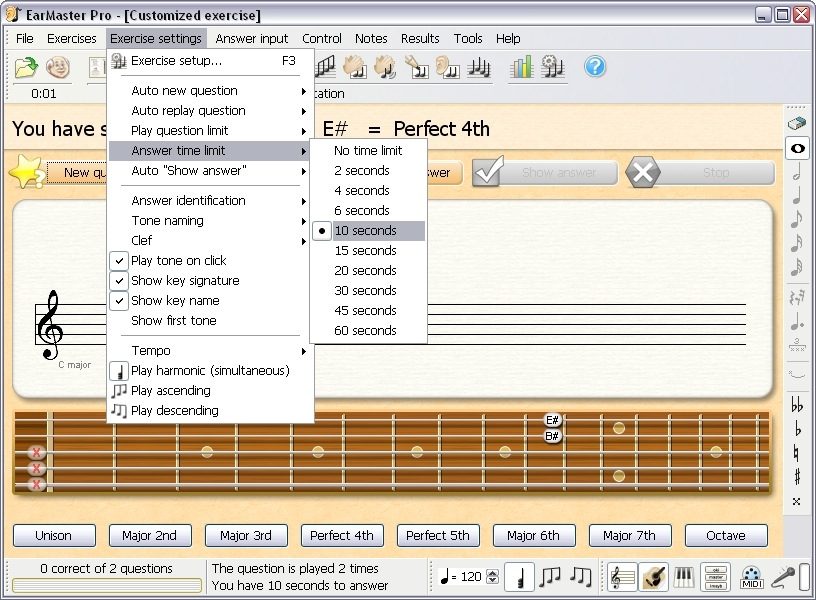
4. EarMaster
EarMaster has been around for a while (it’s currently on version 7) and it’s a total classic for a reason.
It integrates well into traditional musicianship teaching, making it perfect for music students.
5. Quiztones
Quiztones has a simple interface with sleek design. It can quiz you on files from your own music library as well as common sources like drums, bass, guitar and vocals.
6. Soundgym
Soundgym offers a ton of ear training resources for engineers. You can quiz yourself on frequencies, EQ filter types, gain differences, sound location/stereo impression and more.
7. earPlugins
earPlugins is a great free VST plugin for frequency training. It lives inside your DAW so you can quiz yourself on frequencies right from your sessions.
8. TrainYourEars
TrainYourEars has a cool feature that lets you learn to make EQ corrections instead of guessing affected frequencies. It can design custom training programs for you too.
Aural Skills
Ear training has huge benefits that you’ll notice right away.
It gives you the confidence to trust your ears over everything else. You need to know how to cut through the noise and shape your own sound.
Ear training gives you the confidence to trust your ears over everything else.
With ear training, every time you listen you learn.
So make the most of your listening habits and try the tools on this list to develop your listening skills—they’re all pretty fun to use.
Soon enough you’ll be addicted to working out your ears and hearing your music in ways you never thought you would.