Qemu Vga Drivers For Mac
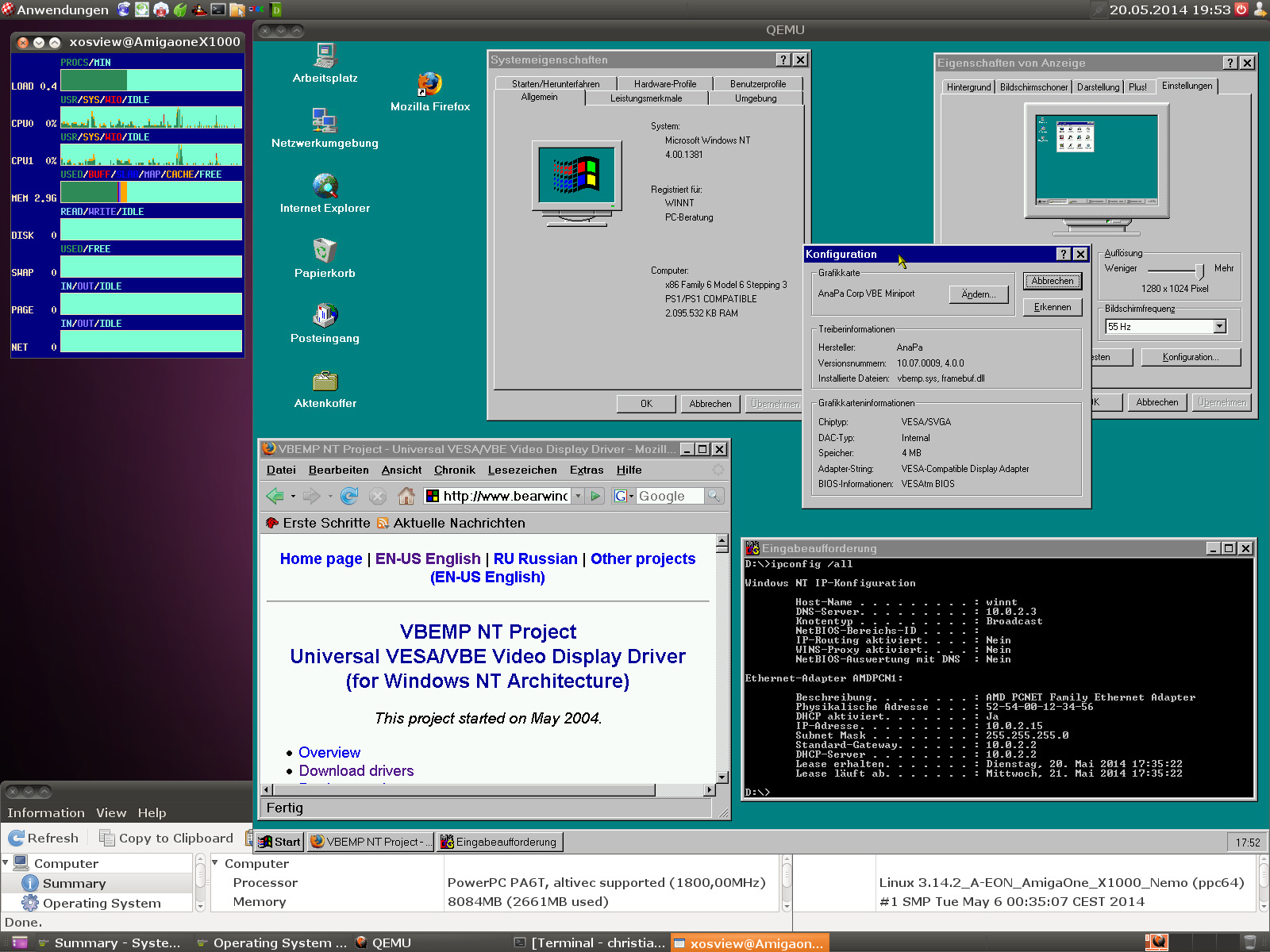
Qemu-vga-driver-custom Custom builds of the QEMU Mac VGA driver For those interested, the built-in resolutions can be changed via hex editor starting at file offset 12298. The values are stored in hex representation of the decimal-based resolution (eg, 00001e0 = 640x480).
Windows 2000 in QEMU
Why would you want to use Windows 2000
- very stable
- easy to use
- low system requirements
- runs faster than Windows XP in QEMU.
Suggested command-line
Compatibility Issues
- The default vga card does not work well. Use '-vga cirrus' to have a fully functioning vga card
- Use '-soundhw sb16' or '-soundhw ac97' for an audio card
- Use '-net nic,model=rtl8139 -net user' to enable networking
- Avoid using the i82557b NIC because it crashes Windows 2000
Programs you may want to use
Doom 95 game demo
Winamp - audio player
.NET 2.0 runtime
SharpDevelop 2.2 - free IDE for developing applications using C#, Visual Basic, and other languages
DJGPP - GCC, GDB, and other developer tools for Windows
Tips
- You can send control-alt-delete to Windows by opening QEMU's monitor window and typing 'sendkey ctrl-alt-delete'. QEMU's monitor window can be accessed by typing control-alt-2.
- The task manager can be accessed by typing taskmgr under Start->Run.
Contacts
Pictures
There are multiple methods for virtual machine (VM) graphics display which yield greatly accelerated or near-bare metal performance.
- 1Methods for QEMU guest graphics acceleration
- 1.2PCI GPU passthrough
Methods for QEMU guest graphics acceleration
QXL video driver and SPICE client for display
QXL/SPICE is a high-performance display method. However, it is not designed to offer near-bare metal performance.
PCI GPU passthrough
PCI VGA/GPU passthrough via OVMF
PCI passthrough currently seems to be the most popular method for optimal performance. This forum thread (now closed, and may be outdated) may be of interest for problem solving.
Looking Glass
There is a fairly recent passthrough method called Looking Glass. See this guide to getting started which provides some problem solving and user support. Looking Glass uses DXGI (MS DirectX Graphics Infrastructure) to pass complete frames captured from the VM's passed-through video card via shared memory to the host system where they are read (scraped) by a display client running on the bare-metal host. Eco tuio drivers for mac.
Fully virtualized GPU support via Intel-specific iGVT-g extension
iGVT-g is limited to Intel graphics on recent Intel CPUs (starting with 5th generation Intel Core(TM) processors). For more information, see this Reddit thread for use on an Arch host system. If you use Libvirt, you might want to check out this blog.
Virgil3d virtio-gpu paravirtualized device driver
Virgil3d virtio-gpu is a paravirtualized 3d accelerated graphics driver, similar to non-graphics virtio drivers (see virtio driver information and virtio Windows guest drivers). For Linux guests, virtio-gpu is fairly mature, having been available since Linux kernel version 4.4 and QEMU version 2.6. See this Reddit Arch thread and Gerd Hoffmann's blog for using this with libvirt and spice.
For Windows guests, there is very little information on VirtIO-gpu OpenGL drivers. A project summary, the DOD (Windows kernel) driver and the ICD (Windows userland) driver are available. In addition, see this Phoronix article and its comments.