Is There A Ready To Use Egpu For Mac
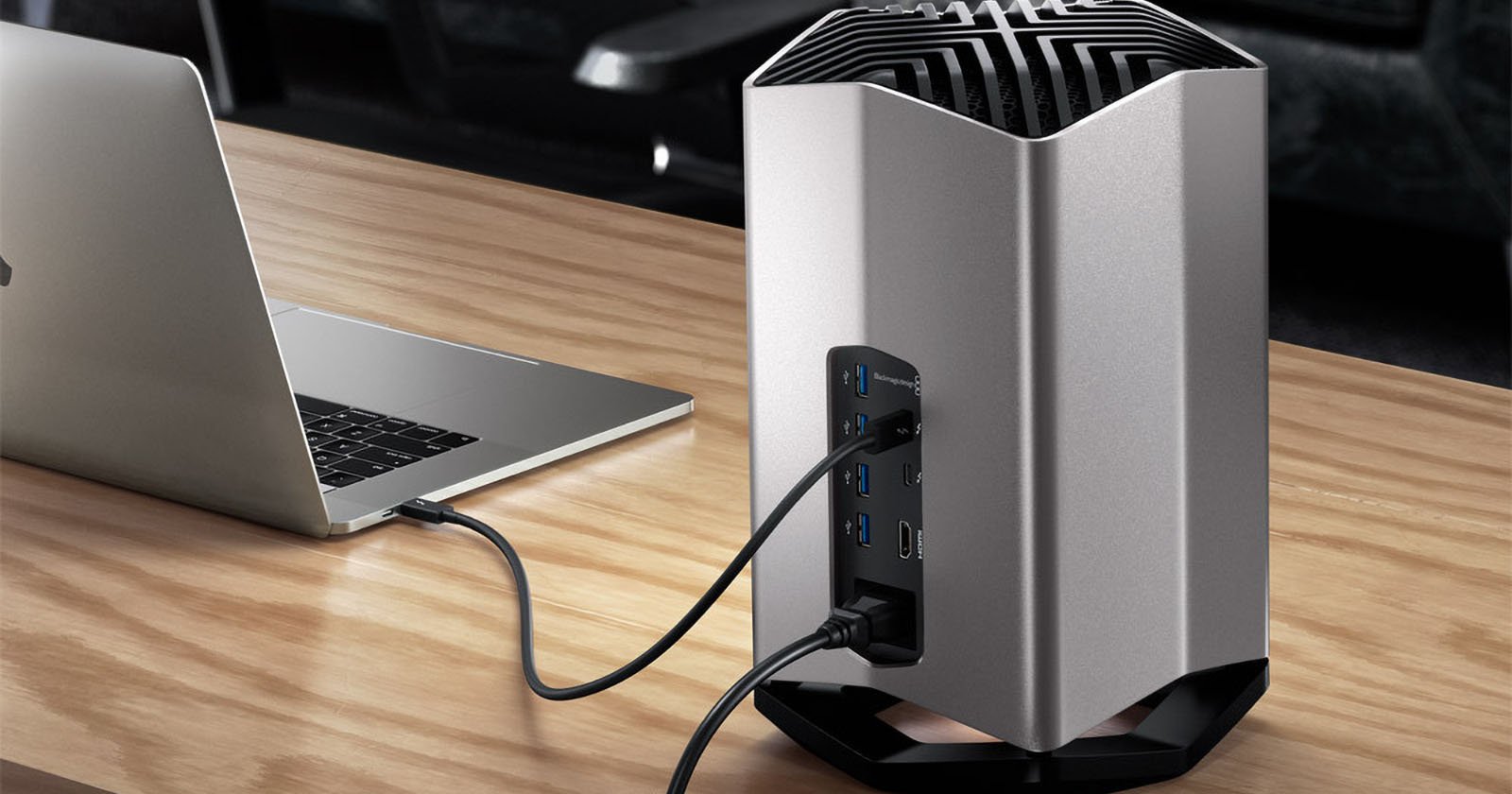
Thunderbolt eGPU for Mac is becoming more of a reality than it has ever been. With the demands of VR development, 4K video editing, and immersive video games, the performance boost of an external graphics card would enable your Mac to do things Apple didn’t think you could.
By Vadim Yuryev
Saturday, February 16, 2019, 08:59 am PT (11:59 am ET)
In a previous comparison where the 2018 Mac Mini was put against the iMac 5K, it was decided the Mac mini is a great option for users who don't really need best-in-class graphical performance, such as for photo editing and other intensive media tasks. The Mac Mini doesn't pack a dedicated graphics card, and it definitely lags behind the iMac 5K which is supplied with a Radeon Pro GPU.
However, the Mac Mini does sport four Thunderbolt 3 ports, which means there is the opportunity of hooking up an eGPU, an external enclosure that houses a graphics card.
The actual setup process for the eGPU on the Mac mini is relatively straightforward, regardless of whether it is a separately bought graphics card and enclosure or a premade unit. If bought separately, insert the graphics card into the enclosure's PCI-e slot and insert the power connectors into the card. Plug your monitor into the card, then plug the enclosure into an outlet and connect it to the Mac mini's Thunderbolt 3 port.
Once connected, macOS should instantly recognize the eGPU and automatically start using it for graphics rendering.
Price comparisons
For the purposes of this test, a powerful $400 Radeon RX Vega 64 graphics card will be attached to the Mac mini using a $250 Sonnet 550-Watt eGPU enclosure via Thunderbolt 3. It is worth noting the enclosure is also capable of providing 87 Watts of power delivery, allowing it to recharge a connected MacBook for those interested in giving their portable Mac more graphical grunt.
The Mac mini next to the Sonnet eGPU enclosure
The Mac mini in this case is upgraded with an Intel Core i7 processor and 512 gigabytes of storage. Instead of upgrading the RAM to 32 gigabytes for $600 through Apple, a 32-gigabyte upgrade kit was acquired for the far cheaper cost of $200. Following a memory swap, the total cost of the Mac mini in this case is approximately $1,700.
The price of the Vega 64 eGPU brings the entire boosted Mac mini setup to $2,350, excluding the monitor and peripherals. Add these extras on, and you're getting quite close to the cost of a similar-specification iMac 5K.
Just on comparative specifications, those switching from PC to Mac or upgrading from an earlier Mac mini model are likely to have their own mouse, keyboard, monitor, and in the case of the PC user, potentially even an AMD graphics card to add to an empty eGPU enclosure. In this sort of situation, opting for the Mac mini is probably going to offer the better overall value for money.
In the event you don't need all of the power offered by the Vega 64, an alternative option is to acquire a $200 RX 580 graphics card and combine it with the $200 350-Watt Sonnet eGPU enclosure. Going for these cheaper options brings the overall cost down to $2,100, saving $250.
The eGPU enclosure is a considerable investment in terms of desk space
Realistically, you can also save a good amount of cash on the Mac mini by opting for a smaller storage capacity, using less RAM, or maybe just going with the i5 processor instead of the i7 if you don't need that much processing power.
Performance
The main downside to using an eGPU is that it isn't as efficient as using an internal graphics card. The Thunderbolt 3 for a variety of reasons can shave off some performance compared to a native PCI-E connection, or a built-in version.
As part of the testing, the Radeon RX Vega 64 eGPU was put against the discrete Radeon Pro 580 in the iMac 5K and the Vega 56 installed in the iMac Pro. Both discrete cards are less powerful than the Vega 64 in the eGPU, but benefit from a wider data path than the Thunderbolt 3 eGPU.
Looking at raw performance in Geekbench 4's Metal test, the Mac Mini with Vega 64 scored similarly to the iMac Pro with the Vega 56 card, but quite a bit less than the iMac Pro with the same Vega 64 GPU. More importantly, the Mac mini using the eGPU achieves a score over six times greater than without the enclosure.
Synthetic benchmarks are a decent approximation of everyday tasking, but aren't a good indicator of specific performance on every given task. AppleInsider has its own real-world tests involving video editing in Final Cut Pro X. The tests also provide more variation in terms of load sharing, with some elements relying more on the processor than the eGPU, which can have more of a bearing on the final scores.
Starting with the BruceX Final Cut Pro benchmark, the Mac mini with the eGPU is right up there with the iMac Pro, and is even faster than the iMac 5K. Compared to the Mac mini by itself, there is a considerable performance increase with the external card.
In a test for stabilizing a 20-second 4K clip, the eGPU-equipped Mac mini is actually slower than both the iMac Pro and the iMac 5K, but again is still a marked improvement over the Mac mini alone, running approximately 3.5 times faster. The slowness despite having a more powerful card is likely down to the inefficiencies of using an externally-located graphics card.
In another video test exporting a 5 minute 4K project, the Vega 64 helps the Mac mini finish over twice as fast as a stock model, but it's unfortunately still slower than the iMacs. This is somewhat surprising as the Mac mini's processor and eGPU are both more powerful than what is offered in a top-of-the-line iMac 5K.
 Moving on to a 5 minute 4.5K RED RAW project, the Mac mini actually outperforms the iMac 5K, as the Red RAW codec is extremely processor intensive rather relying than eGPU-based processing. Since the Mac mini's processor is faster, it finishes quicker than the iMac 5K.
 In the last test, exporting a 60p Canon Raw Lite project, the Mac mini is yet again slower than the other two, because it is a less processor-intensive task, and more of GPU-bound one. However, it was able to play back the project at 52 frames per second compared to only 45 on the iMac 5K. The iMac Pro played back at the full 60 frames per second.
The result dropped down to around 22 frames per second in the Canon Raw project when the display was plugged directly into the Mac mini, instead of into the eGPU. Treat this as a warning that, if you ever use an eGPU, make sure the monitor is plugged directly into the enclosure.
A mixed result
If you already own a 2018 Mac mini, getting an eGPU can really boost graphics performance compared to the stock specification, but graphical power is your primary differentiator between the Mac Mini and the iMac 5K, just go with the iMac. It performed better in almost every test put to all of the models, even though the processor and graphics card aren't as powerful as the Mac mini's processor and the eGPU's graphics card. There is also the benefit of having a beautiful 5K display to use at the same time and minimal desk usage due to being an all-in-one unit.
Throughout, the iMac Pro showed itself to be a viable alternative to both of the other Macs, passing with decent results in all of the tests. It may not necessarily offer the cost savings of a Mac mini with an eGPU, but it is certainly an option for those looking for reliable performance.
Where to buy
Shoppers looking for the lowest prices on Apple's 2018 Mac mini can save $50 to $100 on every configuration with coupon discounts and/or instant rebates at Apple authorized resellers. Prices start at $749, with select retailers collecting sales tax in select states only. Sonnet's eGFX Breakaway Box eGPU enclosure is also on sale with prices starting at $199 at Amazon, while an AMD RX 580 graphics card can be found for $179.99 after a $20 rebate.
Meanwhile, current iMac 5Ks are up to $200 off, with prices starting at $1,599.
Created in close collaboration with Apple, Blackmagic Design's Blackmagic eGPU and Blackmagic eGPU Pro bring accelerated pro app workflows, smoother gameplay, and true-to-life VR content creation to your Mac.
Technical specifications
Blackmagic eGPU includes a Radeon Pro 580 graphics processor with 8GB DDR5 memory, giving your connected Mac graphics performance that's similar to a high-end 27-inch iMac.
Blackmagic eGPU Pro includes a Radeon RX Vega 56 graphics processor with 8GB HBM2 memory. This gives your connected Mac graphics performance that's similar to iMac Pro.
In addition to boosting graphics performance, both Blackmagic eGPUs provide 85 watts of charging power to MacBook Air and MacBook Pro.
Blackmagic eGPU has these ports to connect displays and VR accessories:
- Two Thunderbolt 3 (USB-C)
- Four USB 3.0
- One HDMI 2.0
Blackmagic eGPU Pro has these ports:
- Two Thunderbolt 3 (USB-C)
- Four USB 3.0
- One HDMI 2.0
- One DisplayPort 1.4
System requirements
Blackmagic eGPU is compatible with any Thunderbolt 3-equipped Mac running macOS High Sierra 10.13.5 or later. Blackmagic eGPU Pro requires a Thunderbolt 3-equipped Mac and macOS Mojave 10.14.1 or later.

If you have a Mac mini (2018) or Mac Pro (2019) with FileVault turned on, make sure to connect your primary display directly to your computer during startup. After you log in and see the macOS desktop, you can unplug the display from your computer and connect it to Blackmagic eGPU.
To connect Apple Pro Display XDR to Blackmagic eGPU or Blackmagic eGPU Pro, make sure your Mac is running macOS Catalina 10.15.2 and your eGPU has the latest firmware.
Here's how to update the firmware of your eGPU:
- Go to the Blackmagic website.
- Select the DaVinci Resolve, Fusion, and BlackMagic eGPU product family.
- Download and install the latest firmware for your eGPU.
Connect and use Blackmagic eGPU
When you connect Blackmagic eGPU or Blackmagic eGPU Pro to your Mac with a Thunderbolt 3 (USB-C) cable, the eGPU menu bar item appears, indicating that the eGPU is ready for use.
Blackmagic eGPU automatically accelerates the graphics from Metal-based apps on external displays and devices that are connected to the eGPU. You can use Activity Monitor to confirm that your eGPU is in use:
- Open Activity Monitor, which is in the Utilities folder inside Applications.
- Choose Window > GPU History. A graph appears, charting the activity of your computer's internal GPU and Blackmagic eGPU.
To disconnect Blackmagic eGPU, use the menu bar item to safely disconnect the eGPU from your Mac before unplugging the cable.
Use the 'Prefer external GPU' option
Starting with macOS Mojave 10.14, you can turn on 'Prefer external GPU' in a specific app's Get Info panel in the Finder. This option lets Blackmagic eGPU and Blackmagic eGPU Pro accelerate apps on any display connected to the Mac — including displays built in to the Mac:
- Quit the app if it's open.
- Select the app in the Finder. Most apps are in your Applications folder. If you open the app from an alias or launcher, Control-click the app's icon and choose Show Original from the pop-up menu. Then select the original app.
- Press Command-I to show the app's info window.
- Select the checkbox next to Prefer external GPU.
- Open the app to use it with the eGPU.
Learn more about using eGPUs with your Mac.
Installation and Use Rights. MICROSOFT EDGE FOR NON-WINDOWS DEVICES. You may not use tokens the Software uses to call into a Microsoft Azure service separate from the Software.2. Edge for mac os.
Learn more
macOS currently doesn't support eGPUs in Windows using Boot Camp or when your Mac is in macOS Recovery, at FileVault login, or installing system updates.