For Mac Opera
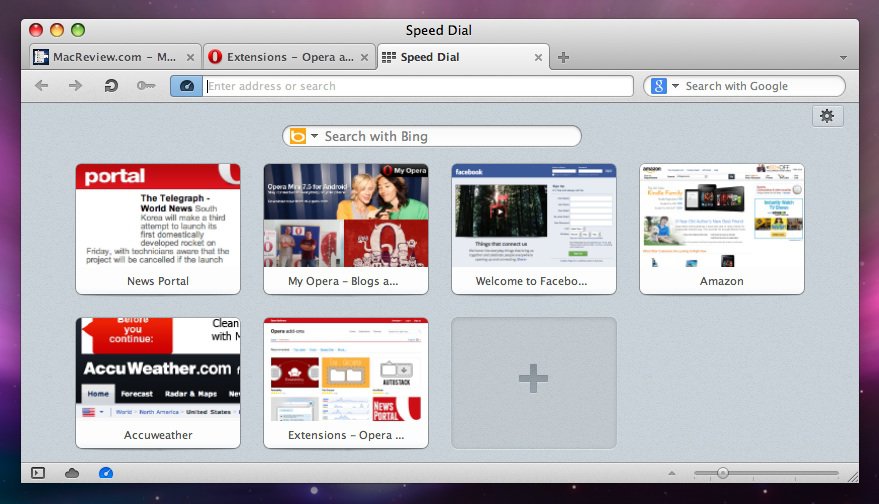
Chrome and Firefox rule on Windows, but on OS X, Opera is the browser to beat.
Opera VPN for Mac is the definition of effortlessly simple, and it delivers surprisingly good download speeds (provided you’ve set Optimal location), and minimal setup. And we must emphasize it again: it’s completely free of charge, ad-free and all that, which is a pretty rare thing for freeware. 6th Omni Web Mac Browser. On the 6th place of the best browser for Mac, we have Omni Web. Looking at history. This web browser is not something new name to people. Omni web was known to people around 15 years ago. The issue that Omni Web faced was that it was not the free and open source. It was available to the Mac users for 40 Dollars approx.
OS X’s native browser, Safari, is excellent. It’s polished and super efficient, and comes with some unique features. But if you’re looking for more flexibility in a browser, Safari falls short. Hfs+ for windows. Eternal favorites Chrome and Firefox can give you that flexibility, but not without some heavy compromises.
As Apple, Google, and Mozilla, keep innovating and improvising in the browser space, the power will no doubt keep shifting from one player to another. Maybe even Vivaldi and Microsoft Edge will join the race as serious contenders, but not Internet Explorer (although you can run Internet Explorer on Mac if needed).
For now, I think that Opera, the underdog in the browser wars, comes out ahead on OS X. Here are three reasons why Opera could work great as the primary browser on your Mac.
@CamBunton @stephenhall_ Opera on my Mac *feels* always better then Chrome to me. I like the slimness of safari UI so I go between these two
— Bauscaus Bzukadnikov (@bauscaus) June 29, 2015
A Fair Balance of Speed and Efficiency
Despite constant improvements, Firefox and Chrome continue to be resource hogs on OS X. On the other hand, Safari consumes just the bare minimum of resources. Opera falls somewhere in between. While it’s not as efficient as Safari, it doesn’t swing to the other extreme as Firefox does. Besides, it stacks up well in usability and customizability as we’ll see further.
Chrome is known to reduce battery life by a good 2-3 hours. Users are reporting that Opera also falls into this category. But it seems that battery life is in general poor on Yosemite as compared to previous versions. That’s why I have been willing to take my chances with Opera and focus on other battery-saving measures Calibrate & Maintain Your MacBook Battery For Best PerformanceIf you correctly calibrate and maintain your MacBook battery, it's possible to improve performance and put off replacing it for as long as possible. Read More .
Rigorous browser benchmark testing Which Browser Is Best? Edge vs. Chrome vs. Opera vs. FirefoxThe browser you're using right now may not be the best one for you. The browser arena changes so frequently that your conclusions from comparisons made last year may be completely wrong this year. Read More was beyond me. I relied on a few random tests and my daily browsing experience to make my decision to switch browsers.
Chrome’s response was slow and erratic in comparison with that of the other browsers. Firefox was okay, but sometimes it wouldn’t load pages unless I disabled Avast’s Web shield. Opera’s and Safari’s response was the smoothest.
The Activity Monitor revealed that Firefox consumed a horrifying amount of memory — way more than the other three browsers. Chrome, and on occasion Opera, was at the top in energy consumption. These results seem to be more or less consistent with the consensus across the Web. I suggest you use Mark’s tips on how to use the Activity Monitor What Is Activity Monitor? The Mac Equivalent of Task ManagerLearn all about Activity Monitor on your Mac and how to use it to check detailed information about your system. Read More and do a few tests of your own.
Switching from Firefox/Chrome to Opera on your Mac could well turn out to be a relief. Switching from Safari would be a compromise that doesn’t feel like one.
A Good Amount of Flexibility
Safari’s clean and minimalist approach to Web browsing is appealing to many, including myself. Its latest version may be the lightest, speediest one yet. But if you have come to depend on the resourcefulness of Chrome extensions or the flexibility of Firefox, Safari feels quite limiting despite the customizations that are possible The Ultimate Guide to Customizing Safari on MacMake Safari an even better browser for your Mac by customizing it. Here's how to tweak it to your liking. Read More . This is where Opera can come to your rescue.
For starters, Opera includes some of the features that we have come to love on Chrome and Firefox. There are narrow tabs with favicons, keyword searches, pinned tabs, true full screen mode — all that’s missing in Safari (at least for now). Opera has a Firefox-like interface that’s familiar and easy to use.
What’s more, you can bring the power of Chrome extensions (not apps, mind) to Opera with Download Chrome Extension. You can’t do this on Firefox, but on Opera you can because the latter runs on the same Webkit-based (Blink) engine as Chrome does. The bottom line is that Opera is perfect for Firefox lovers who wish for the potential of Chrome extensions to come paired with the familiarity of Firefox’s interface.
Note: Before you install an extension from the Chrome Web Store, check if the same one already exists in Opera’s collection of add-ons.
Once you install Download Chrome Extension, you can install any Chrome extension via the Chrome Web Store. Instead of an Add to Chrome button, you’ll see an Add to Opera button. Any extension you install this way will appear disabled by default. You’ll have to visit Opera’s Extensions section to activate it.
A Unique Blend of Features
Let’s not make the mistake of thinking that Opera’s Chrome-like or Firefox-like features are the only thing going for it. It has various nifty features of its own — some of which aren’t available in other browsers unless you use specific add-ons.
To begin with, there’s Opera’s inviting, grid-based visual take on bookmarks. There’s also the innovative Opera Turbo feature. It compresses pages for faster viewing at the click of a button. This comes in handy when you’re working with a bad Internet connection. Then there’s the Discover feature that brings you top stories from around the Web. You can customize what you see based on region as well as areas of interest.
Opera allows you to do a great deal with tabs. You can clone them, pin them, and group them into a speed dial folder. You can also preview them and cycle through them by recency. This is quite time saving, but if you want to revert to the old way of cycling through tabs, you can do so via the browser settings.
Pick from Opera’s decent set of extensions and themes to make Opera feel like home. Add custom keyboard shortcuts and mouse gestures to smooth and speed up your browsing experience.
You can embed certain extensions into the sidebar for quick access. You can also back up and sync your browser data and settings across devices with an Opera account.
It looks like everything you can do in Firefox and Chrome, you can do in Opera, and a lot more besides. As you go about exploring Opera, you’ll realize what an underrated browser it is.
Side note: My Mac (running Yosemite 10.10.3) kept dropping its Wi-Fi connection every couple of minutes. Michael fortunati best rar for mac. This is a known issue that I tried to fix with help from the web. I kept Bluetooth turned off, regenerated network configuration files, used a custom DNS, and tried a few other fixes. Switching from Safari/Firefox to Opera fixed the problem for me. Maybe it was a coincidence, maybe it wasn’t. But I haven’t experienced the Wi-Fi disconnection since the switch.
Mac Users, Give Opera a Chance!
Is Opera the right browser for your Mac? Only you can tell. But it won’t hurt to experiment with it to see if you like it. If you don’t know which to pick, check out our list of alternative web browsers for Mac users 9 Great Safari Browser Alternatives for Mac UsersIt is not that Safari is a bad browser or that it has a limited feature set -- you may just want a different focus, or major updates more than once a year. Read More .
Of course, if you use Firefox for its adherence to open-source principles, switching to a closed-source browser like Opera should give you pause for thought. If you’re coming from Chrome or Safari, this is less of a concern.
Which is your main browser on the Mac? Are you happy with it or does it feel like you’re “settling” till an improved one comes along? Which OS X browser do you wish would up its game?
Opera is one of the most popular browsers on both Mac and PC. Lots of people prefer it to Safari, Chrome, or Firefox for a variety of reasons. You may have downloaded it too and started to use it, perhaps to try it out for yourself because you’ve heard good things about it, or someone has recommended it to you. If you have installed it and no longer use it, or you’re having problems with it, you may want to uninstall it. However, just dragging the Opera app to the Trash won’t uninstall it completely, you’ll need to remove the other files it has placed on your Mac. Here’s how to do that.
How to remove Opera from your Mac
First, you’ll need to quit Opera if it’s running, and then quit any processes that may still be running.
- Go to Applications>Utilities and double-click Activity Monitor to launch it.
- Look for any processes with Opera in the name.
- If you find any, click on them and them press the Quit Process button in the toolbar.
- Once you’ve quit all the Opera process, quit Activity Monitor.
Now, go to your Applications folder and drag the Opera app to the Trash and empty it. Once you’ve done that, you need to remove the other files it has placed on your startup drive
- In the Finder, click on the Go menu and choose “Go to Folder” then type the following into the text box: ~/Library/Caches
- Look for this folder: com.operasoftware.Opera
- When you find it, drag it to the Trash and empty it.
An easier way to uninstall Opera
If all that seems like a lot of work, there is a simpler way to uninstall Opera — use a dedicated uninstaller, like the one in CleanMyMac X. Here’s how it works:
- Download and install CleanMyMac X (free trial available).
- Launch it from your Applications folder.
- Choose the Uninstaller utility.
- Locate Opera in the list of apps and check the circle next to it.
- Press Uninstall.
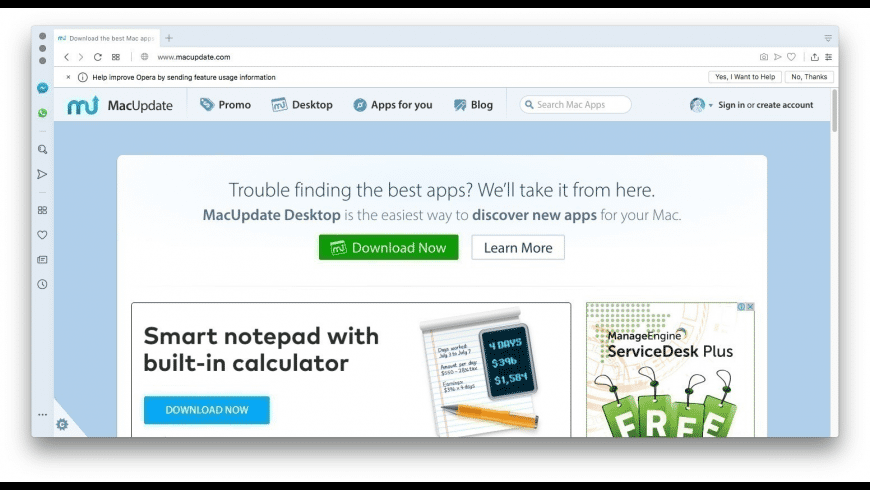
When you press Uninstall, the Opera application and all the files it has installed on your Mac will be removed and you won’t have to remove them manually.
How to reset Opera on Mac
There is an alternative to uninstalling Opera you should consider if your reason for removing it is that it’s causing problems on your Mac. You could try resetting it first. Resetting an app removes some if its settings and preferences files but leaves the app intact. The next time you launch it, it behaves as if you had just launched it for the first time after downloading it. That may solve performance issues. To reset an app in CleanMyMac X, do this:
- Follow steps 1-4 above in the uninstall instructions.
- Instead of pressing the Uninstall button, click on the dropdown menu to the right of the app’s name, where it currently says Uninstall.
- Choose Reset.
- You’ll see that the Uninstall button has changed to Reset. Press it.
- Opera will now be reset.
If that doesn’t help improve performance, you can always go back and uninstall it.
Separately from uninstalling or resetting Opera, you can also remove any files that collect private data, such as cookies and cache files. You can do this in the browser itself, using its Preferences, in the Finder, or, easiest of all in CleanMyMac X. To do that, you should choose the Privacy tool in the Protection section of the CleanMyMac X sidebar.
Opera is a popular and much-used browser, based on Google’s Chromium framework. Lots of people have downloaded and it and tried it out. If you’re one of those people but have now decided you don’t want to use it, it’s a good idea to uninstall it. You can do that manually — though you should remember to move every file it installs to the Trash. Or you can do it quickly using CleanMyMac X. If your reason for uninstalling it is that it slows your Mac down, you may want to try resetting it, which you can also do in CleanMyMac X.